Preserving Kubernetes Skills in an AWS EKS Migration
How a fintech team moved Kubernetes workloads from Azure to AWS while preserving engineering skills and gaining more control over cluster behaviour, networking, scaling, and observability.

When Kubernetes is genuinely required, we shape EKS into a governed, production-ready platform your team can operate, explain, and improve.
Not every container workload needs Kubernetes.
When it does, EKS needs to prove that cluster control, security, reliability, and operating discipline are worth the added platform responsibility.
EKS is shaped around real Kubernetes requirements: APIs, tooling, operators, portability needs, data platforms, or platform team conventions.
Your team gets Kubernetes because the operating model needs it, not because containers were involved.
Access, patching, networking, namespaces, observability, cost signals, and release boundaries are defined before growth adds noise.
Engineering, platform, security, and risk stakeholders can see how the cluster is governed.
EKS supports a consistent Kubernetes control story across the environments where that operating model is genuinely required.
The platform can support reliability, security, and review conversations beyond a single deployment location.
Amazon EKS is the Kubernetes layer when platform requirements justify cluster-level control. We connect that flexibility to managed operations, security integration, cost and performance discipline, and evidence your team can use under review.
Cluster lifecycle, access reviews, namespaces, releases, patching, monitoring, incident signals, and runbooks become part of the operating model.
Cost and performance choices stay tied to real workload behaviour, platform pressure, and the level of control Kubernetes is expected to provide.
Security integrations, reliability signals, audit artefacts, and operational records make Kubernetes explainable to reviewers, not only usable by engineers.
The goal is not Kubernetes for its own sake. It is a managed platform layer that gives your team control where control is justified.
EKS starts with a fit decision. If Kubernetes is justified, we shape the cluster into an operated platform with clear ownership, security, reliability, and review evidence.
Journey
Confirm why Kubernetes is justified: tooling, APIs, portability, data platform needs, migration path, or platform team conventions.
Define lifecycle ownership, access, namespaces, network boundaries, AWS security integrations, release paths, and support responsibilities.
Connect monitoring, incident response, cost and performance optimisation, runbooks, and review artefacts to the cluster.
Move from cluster construction to operated Kubernetes inside the AWS Managed Platform, with support ownership and continuous improvement.
AWS Managed Platform handover
Your team keeps the Kubernetes control it needs while Kinetic Skunk helps carry the operating routines, security evidence, reliability signals, and platform discipline required for production confidence.
Kubernetes choices matter most when they show why cluster-level control was justified and how the platform stayed operable after migration.
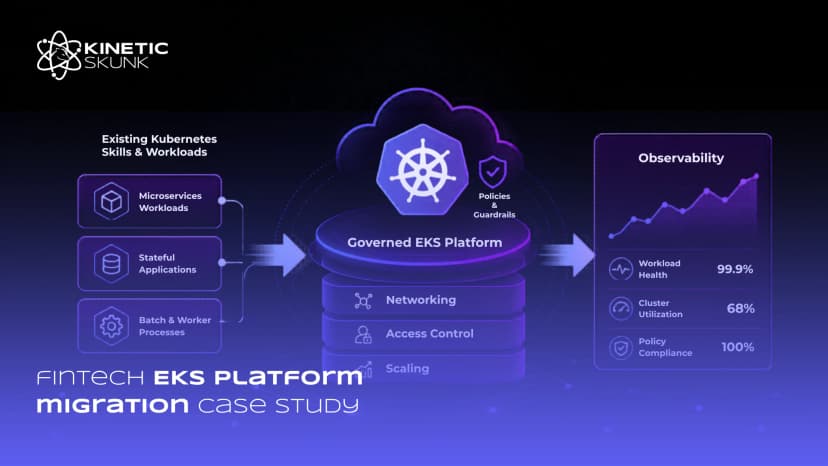
How a fintech team moved Kubernetes workloads from Azure to AWS while preserving engineering skills and gaining more control over cluster behaviour, networking, scaling, and observability.
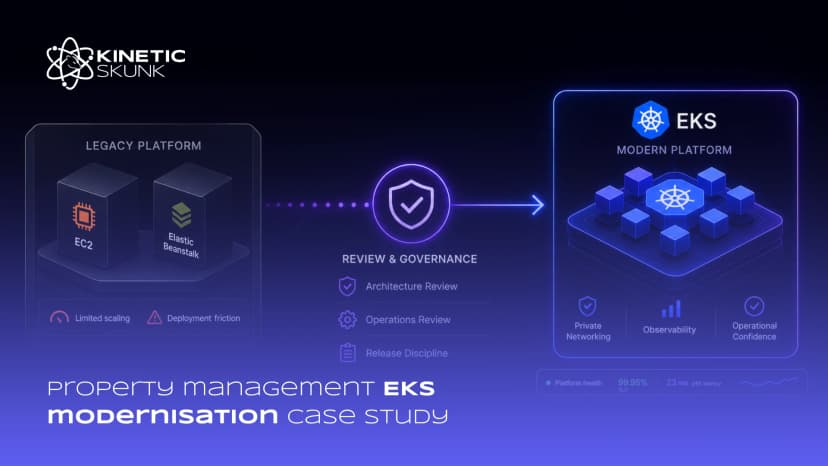
How a property management technology team moved beyond legacy hosting limits with an Amazon EKS platform designed for clearer operations, stronger controls, and future growth.
EKS is one AWS path inside a wider platform story. These routes help your team validate fit, compare the simpler container path, and connect Kubernetes to operated cloud confidence.
See the full AWS programme context, including validation badges, platform pathways, case studies, and delivery model.

Use the pragmatic container path when the workload needs managed orchestration without Kubernetes platform overhead.

Start here when an existing AWS workload needs risk visibility, prioritised remediation, and a clearer platform path.
Connect EKS delivery to the customer-facing operating model for production hosting, evidence, resilience, and support ownership.