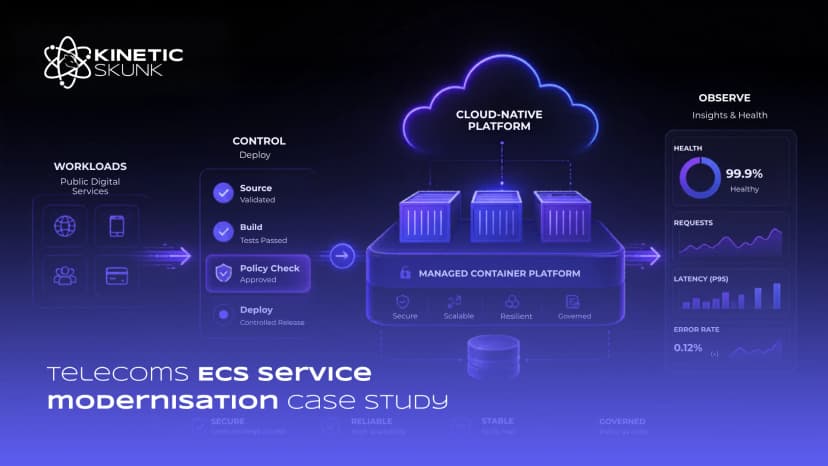
Modernising a Public Digital Service on AWS ECS
How a telecoms team moved a public digital service onto an AWS container platform with stronger deployment control, clearer operations, and better foundations for growth.

ECS gives container teams repeatable releases, governed scaling, and operational clarity without building a platform they do not need.
Not another container service page.
A clear route from container workloads to operated AWS platform confidence.
ECS helps teams run containerised workloads with service definitions, release routines, and ownership that stay visible after launch.
Your application has a clear operating model, not only a place to run.
AWS-managed orchestration, capacity choices, and scaling policy keep the platform focused when the business needs predictable growth.
The workload can grow without turning into a Kubernetes programme by accident.
Monitoring, access patterns, security integrations, and runbooks connect ECS delivery to review-ready platform evidence.
Engineering, risk, and commercial reviewers can see how the workload is controlled.
Amazon ECS is the container compute layer when the workload needs clean scaling, managed orchestration, and operational ownership without adding unnecessary platform weight.
Services, releases, monitoring, access, and incident signals are shaped into routines your team can understand and Kinetic Skunk can operate.
Capacity and scaling choices are tied to real workload demand, cost expectations, and the pressure points the platform must absorb.
Logs, deployment evidence, security controls, and ownership paths make ECS part of the wider audit and reliability story.
The result is not container hosting in isolation. It is a managed platform layer that keeps application delivery, growth, and accountability connected.
ECS is chosen by workload fit, then shaped into operated platform control so the application can scale without drifting into unmanaged complexity.
Journey
Map application boundaries, release patterns, scaling pressure, network needs, and the evidence stakeholders expect.
Define service configuration, IAM, networking, deployment path, scaling policy, observability, and cost ownership before growth adds noise.
Move ECS into managed routines with monitoring, runbooks, incident signals, release evidence, and support ownership.
AWS Managed Platform handover
Your team keeps product momentum while Kinetic Skunk carries the operational routines, review evidence, and scaling discipline needed for production confidence.
Container choices matter most when they improve delivery pressure, security discipline, and cost control in the real world.
How a telecoms team moved a public digital service onto an AWS container platform with stronger deployment control, clearer operations, and better foundations for growth.
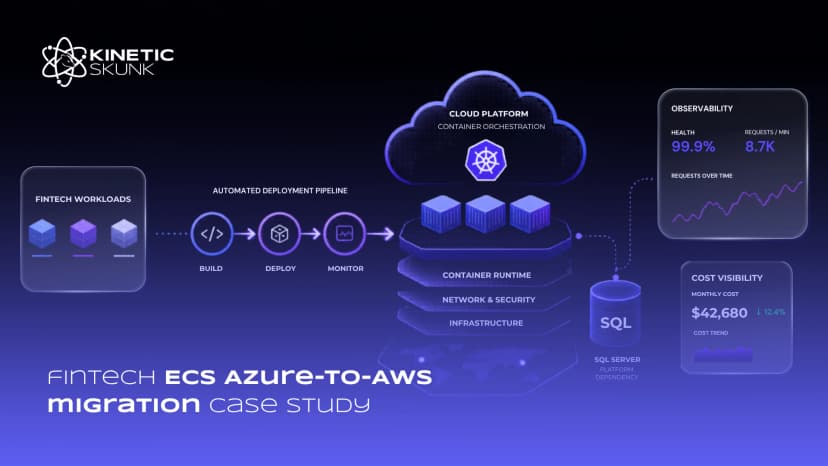
How a fintech team used AWS ECS to simplify container operations, improve deployment control, and gain clearer visibility across application hosting costs and platform ownership.
ECS is one AWS path inside a wider platform story. These pages help you choose the right next step without turning the decision into a service catalogue.
See the full AWS programme context, including validation badges, platform pathways, case studies, and delivery model.

Start here when an existing workload needs risk visibility, prioritised remediation, and a clearer platform path.
Use the Kubernetes path when cluster-level control, Kubernetes APIs, or platform portability are justified by the workload.
Connect ECS delivery to the customer-facing operating model for production hosting, evidence, resilience, and support ownership.