Situation at a glance
- Industry: telecommunications, with a customer-facing digital service.
- Platform decision: use ECS where container orchestration was needed without Kubernetes overhead.
- Outcome framing: published claims stay qualitative unless separately approved proof is available.
Context and public service pressure
Core points
- A public digital service had to keep pace with demand, product change, and operational scrutiny.
- Ownership needed to become clearer across application delivery, infrastructure, and support teams.
- The platform needed a stronger containerisation operating model without adding avoidable Kubernetes overhead.
ECS architecture and service choices
Core points
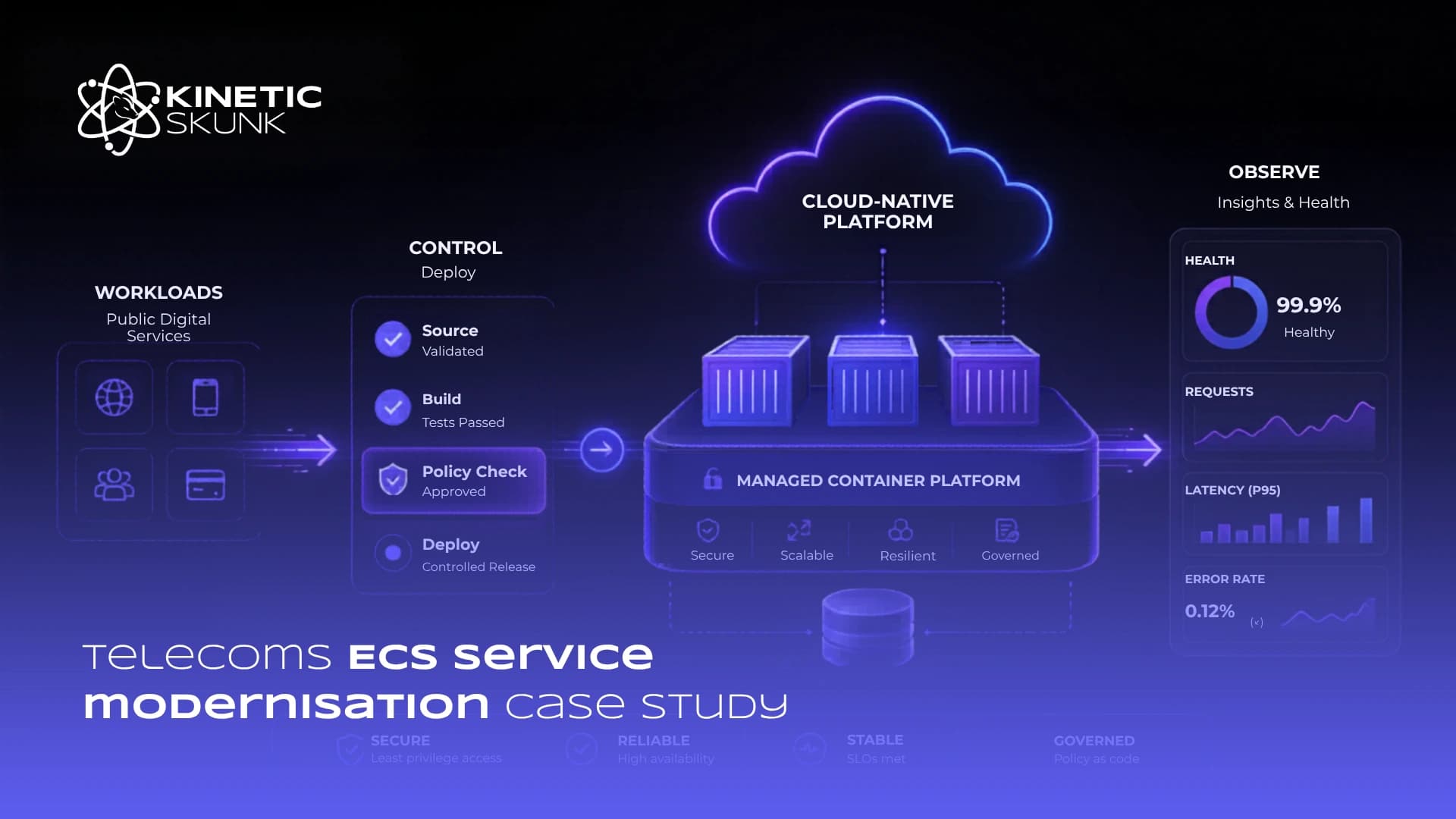
- The service was rebuilt around Amazon ECS, with workloads distributed across multiple Availability Zones and traffic managed through Application Load Balancer.
- Supporting services included managed NoSQL data storage, S3-hosted assets, ECR, CodeBuild, IAM, Systems Manager, CloudWatch, VPC design, and Transit Gateway connectivity.
- The architecture connected compute, networking, access control, deployment automation, and observability into one AWS partner services operating model.
Delivery milestones and operating controls
Core points
- Container image management and build automation improved deployment control without changing the team into a platform engineering programme overnight.
- Network connectivity, access controls, and service-health visibility became part of the delivery path, not a separate afterthought.
- The work created a clearer basis for support teams to understand, operate, and improve the platform.
Skunk tip
- Start with traffic routing, network boundaries, and access ownership before tuning the deployment tooling.
Measured outcomes and lessons
Core points
- Deployment paths became clearer and operational visibility improved across the public-service platform.
- The improved foundation supports future scaling conversations without making public numeric uptime, performance, or savings claims.
- The main lesson is that ECS can fit teams that need container automation without unnecessary platform complexity.
A container platform only creates confidence when deployment, networking, access, and observability move together.